

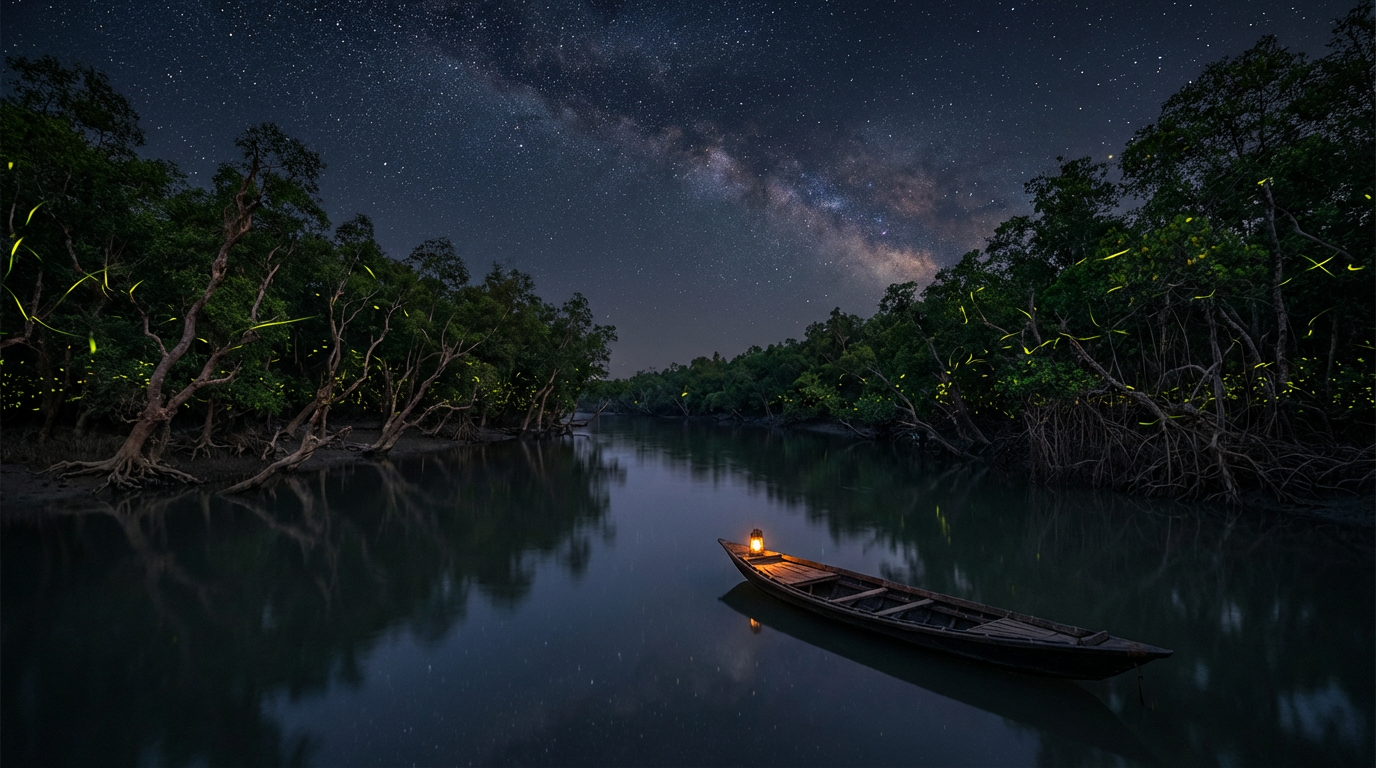
The Sundarbans after sunset is a different forest altogether. Daylight reveals tigers, crocodiles, and mudflat drama — but once the sun drops below the mangrove line, an entirely separate cast of characters takes the stage. A Sundarban night safari puts you on a quiet boat drifting through tidal creeks while fireflies synchronize along the banks, fishing owls call from low branches, and bioluminescent plankton trace your wake in pale blue light. It is one of the most atmospheric wildlife experiences available anywhere in eastern India.
Night safaris are not widely promoted, which is exactly why they feel so special. This guide covers how the experience works, what wildlife you can encounter after dark, and how to book a tour that includes this extraordinary addition. If you have already explored the daytime route through our Sundarban boat safari guide, consider the night safari its unmissable companion.
How a Sundarban Night Safari Works
A typical Sundarban night safari begins at dusk — roughly 5:30 PM in winter and 6:30 PM during summer months. Your group boards a small motorboat or a traditional country dinghy from the resort jetty. The engine cuts once you enter a narrow creek, and the boatman uses a pole or paddle to drift silently through the mangrove corridor.
The route follows interior tidal channels where the canopy closes overhead, creating a natural tunnel. Guides carry infrared torches or low-lumen red-filtered flashlights that reveal wildlife without disturbing it. Safaris last between 90 minutes and two hours, depending on the tidal window and the operator. You return to the resort before dinner, carrying memories that no daytime itinerary can replicate.
Operators do not run night safaris inside the core tiger reserve zone — those creeks close at sunset by Forest Department regulation. Instead, the safari follows buffer-zone waterways and village-fringe creeks where nocturnal biodiversity is surprisingly dense. This keeps the experience legal, safe, and still remarkably wild.
Wildlife You Can Encounter After Dark
The star attraction is the synchronous firefly display. Between October and March, colonies of Pteroptyx fireflies light up specific mangrove trees in rhythmic flashes — hundreds pulsing together like living fairy lights. The phenomenon is best witnessed on moonless or low-moon nights when the contrast against the dark canopy is sharpest.
Beyond fireflies, the night forest is rich with sound and movement. Brown fish owls perch on low branches over the water, hunting mudskippers and small crabs. Indian nightjars call from sandy banks. Water monitors and small-clawed otters forage along the mudflat edge. Saltwater crocodiles — often invisible during the day — reflect torchlight with an unmistakable orange-red eye shine from the waterline.
If conditions align, you may also see bioluminescent plankton in the water itself. Disturbed by the boat hull, dinoflagellates emit a ghostly blue glow that trails behind the vessel. Combined with the starfield overhead and total absence of artificial light, the visual is genuinely otherworldly. For more on the wildlife you share these creeks with, read the Sundarban wildlife safari complete guide.
Best Time and Conditions for a Night Safari
The ideal window runs from October through February — the post-monsoon and winter months when skies are clearest and firefly activity peaks. New-moon nights offer the darkest canvas and the most dramatic firefly contrast. Avoid full-moon nights if fireflies are your priority, though moonlit safaris have their own silver-lit beauty along the wider rivers.
Tidal timing matters as well. A rising or high tide allows the boat to access narrow inner creeks that become impassable mudflats at low tide. Your operator checks the tide table for the specific date and plans departure accordingly. During monsoon months (June–September), night safaris may be suspended due to strong currents, cyclone risk, and reduced visibility.
What to Carry and How to Prepare
Travel light and dark. Avoid white or bright clothing — it attracts insects and reflects too much light. Carry a good DEET-based mosquito repellent and apply it liberally before boarding. A lightweight windbreaker helps against the river chill that sets in after sunset, especially between December and February when creek-level temperatures can drop to 10–12 °C.
Leave the flash off your camera. A phone with night mode works better than a DSLR with flash — the burst of white light startles wildlife and ruins other guests’ dark adaptation for several minutes. Binoculars with good light-gathering optics (42 mm objective lens or larger) are worth carrying if you own a pair. Browse options that include this experience on the Sundarban tour packages page, or reach out directly for a custom night-safari itinerary.
Frequently Asked Questions
Is a Sundarban night safari safe?
Yes. Night safaris operate in buffer-zone creeks outside the core tiger reserve. Boats are guided by experienced local boatmen, and operators carry communication equipment and first-aid kits. Wildlife observation is done from the safety of the boat at all times.
Can I see tigers during a Sundarban night safari?
Tiger sightings are extremely rare at night because safaris run outside the core zone. The experience focuses on fireflies, nocturnal birds, crocodile eye shine, bioluminescent plankton, and the overall atmosphere of the mangrove forest after dark.
When is the best time for a Sundarban night safari?
October to February offers the best conditions — clear skies, peak firefly activity, and comfortable temperatures. New-moon nights provide the darkest skies and the most spectacular firefly displays.
How long does a Sundarban night safari last?
A typical night safari lasts 90 minutes to two hours, starting around dusk and returning before dinner. The duration depends on tidal conditions and the specific creek route chosen by the guide.
Is the Sundarban night safari included in regular tour packages?
Some 2-night and 3-night packages include a night safari as part of the itinerary. If your chosen package does not include it, Sundarban Ecofriends can add it as an optional activity. Contact us via WhatsApp for availability.