

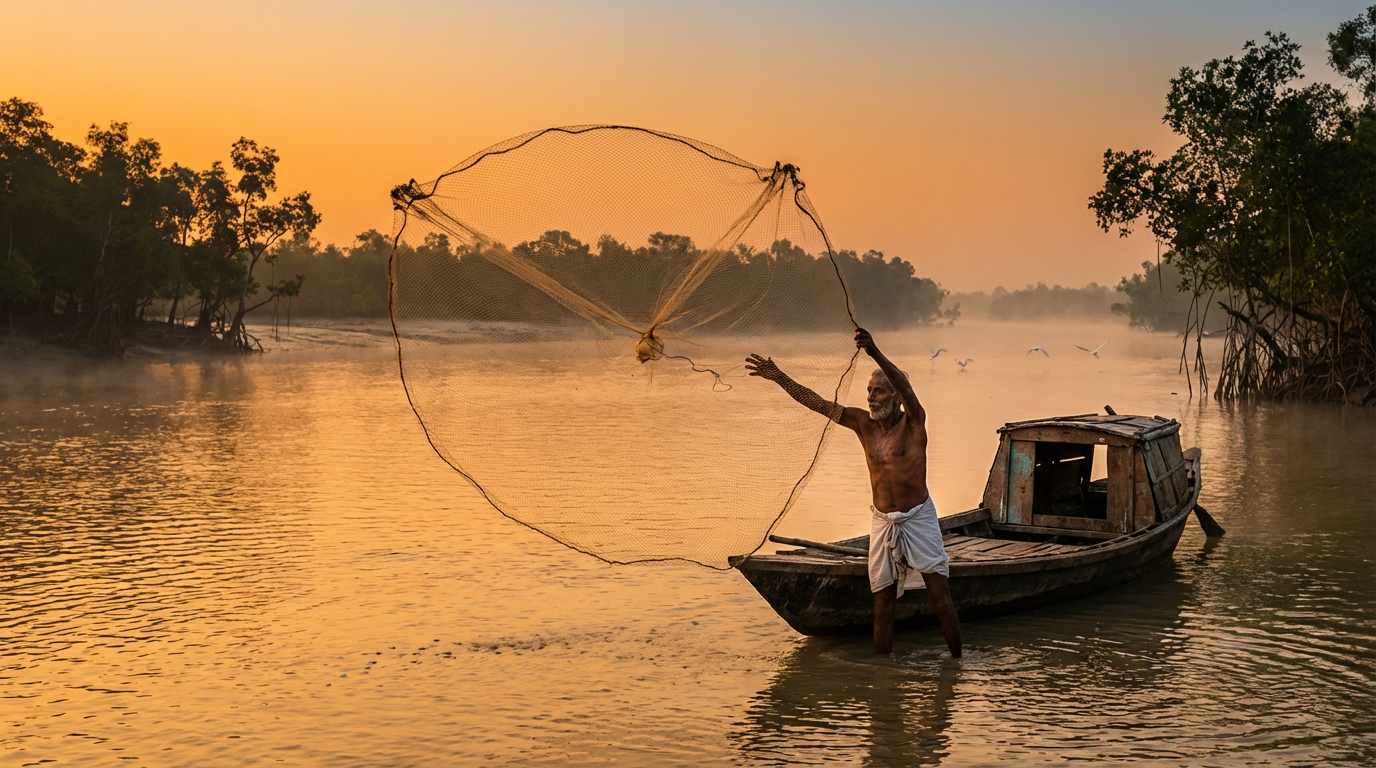
Long before the Sundarbans became a tiger reserve and tourist destination, it was — and still is — a fishing delta. Millions of families across the 102 islands depend on rivers, creeks, and tidal channels for their daily catch. A Sundarban fishing tour takes you out of the safari boat and into the working life of the delta, where you join local fishermen at dawn, learn to throw a cast net, pull prawn traps from muddy creek beds, and understand a fishing culture that has survived for generations without modern technology.
This is not a sport-fishing excursion with rods and reels. It is a cultural immersion — slow, hands-on, and deeply connected to the rhythm of the tides. If you want to experience the Sundarbans the way its people do, a fishing tour is the most authentic way in.
How a Sundarban Fishing Tour Works
Your Sundarban fishing tour typically begins before sunrise. A local guide rows you out on a narrow country boat — a “dingi” or “nouka” — into a tidal creek away from the main safari routes. The fisherman accompanying you carries a folded cast net, a bundle of nylon gill nets, and a few bamboo prawn traps called “chāng” or “ber jaal.” There is no engine noise, no crowd — just the sound of water slapping against the hull and the occasional call of a kingfisher from the mangrove canopy.
You begin with the cast net. The fisherman demonstrates first — a fluid, spinning throw that opens the weighted net into a perfect circle above the water. Then you try. It takes several attempts before the net opens even halfway, and the locals laugh with you, not at you. When it finally lands flat and sinks, you haul it back and find small silver fish, mud crabs, or — if the tide is right — a handful of fat river prawns called “bagda chingri,” the same species that supplies Kolkata’s finest restaurants.
What You Catch and What You Learn
Depending on the season and tidal cycle, your catch may include “bhetki” (barramundi), “parse” (mullet), “tangra” (catfish), tiger prawns, and small crabs. The fisherman explains which species are kept, which are released, and which channels produce the best catch at which tide. You learn to read the water — the direction of the current, the colour of the silt, the way fish break the surface when oxygen levels shift during a turning tide.
Prawn trapping is another highlight. Bamboo cages baited with rice bran and mustard cake are lowered into creek mouths during the incoming tide. You return a few hours later to haul them up, often finding a wriggling harvest of freshwater and brackish-water prawns. This is the backbone of the Sundarban economy — and handling the traps yourself gives you a visceral appreciation for how hard delta families work for modest earnings. To see how fishing fits into the broader community rhythm, explore the Sundarban local village tour.
Best Time and Practical Details
Fishing tours run year-round, but the best months are October through March when tidal patterns are predictable and the weather stays dry. Monsoon months (June–September) bring larger catches but rougher water and heavier rain. The ideal session starts at dawn and lasts three to four hours, returning to the resort in time for a late breakfast — often cooked with the morning’s catch.
Most fishing experiences are add-ons to a standard 2-night / 3-day Sundarban package. Sundarban Ecofriends includes a guided fishing session as part of its cultural itinerary, paired with a boat safari on the other mornings. No prior fishing experience is required — the local fishermen are patient teachers, and the equipment is traditional and safe. Check the Sundarban tour packages page for itineraries that include a fishing session.
Why a Fishing Tour Matters
Tourism in the Sundarbans has historically focused on tigers. That single-species spotlight brings visitors but channels most spending away from the communities who actually live in the delta. A fishing tour redirects attention and revenue toward local fishermen, giving them an additional income stream that does not deplete fish stocks. You pay for their time, their knowledge, and their company — not for the size of your catch.
It also changes how you see the Sundarbans. After spending a morning waist-deep in a tidal creek, hauling nets alongside someone who has done it since childhood, the mangrove forest stops being a backdrop for wildlife photographs. It becomes a living workplace — beautiful, dangerous, and deeply human. That shift in perspective is the real souvenir of a Sundarban fishing tour.
Frequently Asked Questions
Do I need fishing experience for a Sundarban fishing tour?
No prior experience is needed. Local fishermen guide you through every step — from casting nets to hauling prawn traps. Equipment is traditional and safe, and the pace is relaxed so everyone can participate regardless of skill level.
What fish and seafood can I catch during the tour?
Common catches include bhetki (barramundi), parse (mullet), tangra (catfish), tiger prawns (bagda chingri), mud crabs, and freshwater prawns. The exact catch depends on the season, tidal cycle, and creek location.
How long does a fishing session last?
A typical guided fishing session lasts three to four hours, starting at dawn and finishing by late morning. Some tours offer an additional evening session during the outgoing tide for prawn trapping.
Is the fishing tour included in standard Sundarban packages?
Sundarban Ecofriends includes a guided fishing experience as part of its cultural itinerary on most 2-night and 3-day packages. It can also be added to any custom itinerary on request.
Can I cook and eat what I catch?
Yes. The morning’s catch is typically brought back to the eco-resort kitchen, where the local cook prepares it as part of your Bengali lunch — often as a fresh fish curry or prawn malaikari with steamed rice.