

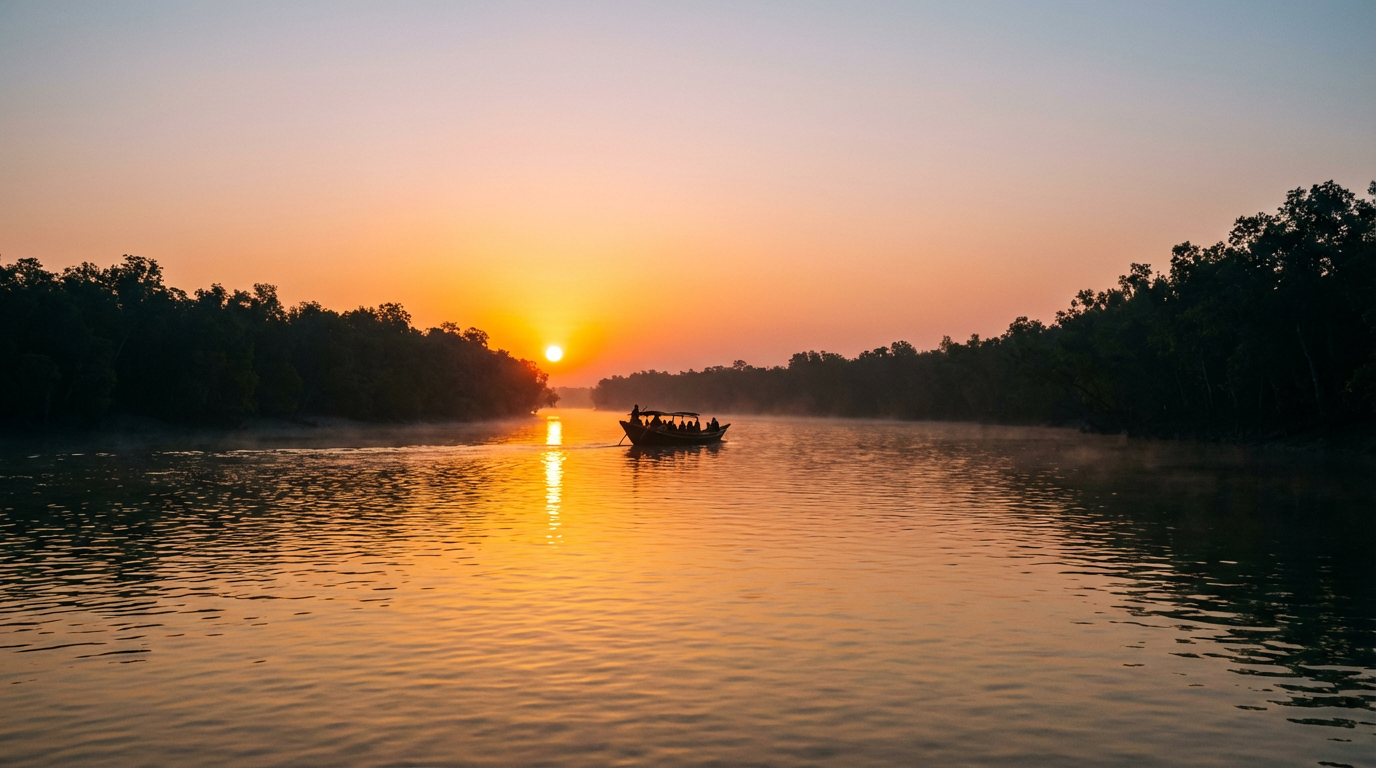
There is a moment, just before the sun clears the eastern mangroves, when the entire Sundarban delta holds its breath. The water turns molten gold, egrets lift off in slow motion, and the only sound is the low chug of your safari boat. A Sundarban sunrise is not something you simply watch — it is something you feel. And when the same sky catches fire again at dusk, framing silhouetted Heritiera trees against streaks of orange and violet, you understand why golden hour in the world’s largest tidal mangrove forest is considered one of eastern India’s greatest natural spectacles.
Why Sunrise and Sunset in the Sundarbans Feel Different
Unlike hilltop or coastal sunrises, a Sundarban sunrise sunset view unfolds at eye level across a vast, flat waterscape. There are no buildings, no power lines, and no artificial light. The horizon is an unbroken ribbon where river meets sky, and the mangrove canopy provides a dramatic natural frame. Because tidal creeks run in every direction, the light bounces off water on all sides, doubling the intensity of colour. Morning mist that clings to the surface adds a soft-focus quality that photographers travel thousands of kilometres to capture.
At sunset, the dynamic reverses. Falling tides expose mudflats where mudskippers glint in amber light, while flocks of kingfishers and open-billed storks silhouette against a dimming sky. If you are on an overnight Sundarban boat safari, the transition from sunset to starlight is seamless — and equally spectacular.
Best Spots to Watch Sunrise and Sunset on Safari
Not every stretch of the delta delivers the same visual drama. These locations are consistently rated the best by naturalists and returning travellers:
- Sajnekhali Confluence: Where the Matla and Bidya rivers merge, offering a 270-degree water horizon. Early-morning mist here creates ethereal layered light — ideal for wide-angle photography.
- Sudhanyakhali Creek Approach: The narrow channel leading to the tiger camp faces due east. Sunrise light tunnels between tall Sundari trees, casting long reflections on still water.
- Dobanki Canopy Walk Platform: Elevated above the canopy, this platform provides an unobstructed western view perfect for sunset. Watch the sky shift from gold to crimson while scanning the treeline for wildlife.
- Pirkhali–Panchamukhani Junction: A remote wide-river spot on multi-day itineraries. Minimal boat traffic means the water is mirror-calm at dawn, producing flawless reflections.
- Netidhopani Open River: The approach channel faces southwest, delivering spectacular sunsets. Ruins of a 400-year-old temple add a moody foreground element to photographs.
For the best Sundarban photography tour tips — including lens choices and camera settings for golden hour — check our dedicated guide.
Ideal Timings and Season for Golden Hour
Sunrise in the Sundarbans occurs between 5:15 AM (summer) and 6:10 AM (winter). The richest colour window lasts roughly 20 minutes before and after the sun breaks the horizon. Sunset ranges from 5:05 PM (December) to 6:30 PM (June), with peak colour appearing 15 minutes before the sun dips below the treeline.
The best months for dramatic skies are October through February. Winter mornings produce thick river mist that diffuses light into painterly layers, while clear post-monsoon evenings in October–November deliver the most vivid sunsets. Monsoon months (June–September) occasionally reward photographers with storm-lit skies, but heavy cloud cover makes golden-hour sightings unpredictable.
Photography Tips for Sundarban Sunrise and Sunset
Capturing the magic of a Sundarban sunrise sunset view from a moving boat requires preparation:
- Use a fast shutter speed (1/500 s or higher) to counter boat vibration. Stabilised lenses or in-body IS help enormously.
- Shoot in RAW to preserve highlight and shadow detail in high-contrast golden-hour scenes.
- Include foreground elements — the bow of the boat, a fishing net, or a mangrove root — to add depth and narrative.
- Bracket exposures for silhouette shots. Underexpose by 1–2 stops to deepen sky colour and sharpen tree outlines.
- Protect your gear: Morning dew and salt spray are constant. Keep a microfibre cloth handy and seal camera bags when not shooting.
Even smartphone cameras produce striking results during golden hour thanks to the naturally warm, low-angle light. Burst mode on any modern phone captures sharp silhouettes of boats and birds in motion.
Book a Sunrise-to-Sunset Safari Experience
The only way to witness both sunrise and sunset on the same trip is to stay overnight inside the reserve — either aboard a houseboat or at an island eco-lodge. Sundarban Ecofriends offers multi-day Sundarban tour packages designed to maximise golden-hour encounters: early-morning creek safaris, rooftop sunset viewings, and night-sky sessions after dark. Share your travel dates via WhatsApp, and we will build an itinerary that puts you in the right place at exactly the right light.
Frequently Asked Questions
What time is sunrise in the Sundarbans?
Sunrise varies by season — approximately 5:15 AM in summer (May–June) and 6:10 AM in winter (December–January). The best colour window lasts about 20 minutes before and after the sun clears the mangrove horizon.
Which is the best spot to watch sunset in the Sundarbans?
Dobanki canopy walk platform and the open river approach near Netidhopani are widely regarded as the best sunset viewpoints. Both offer unobstructed western views and dramatic mangrove silhouettes.
Can I photograph sunrise from the safari boat?
Yes. Safari boats are the primary platform for sunrise photography in the Sundarbans. Use a fast shutter speed (1/500 s or higher) and image stabilisation to counter boat movement for sharp results.
Which months have the most dramatic sunrise and sunset colours?
October through February delivers the most vivid golden-hour colours. Winter mist creates layered, painterly sunrises, while clear post-monsoon evenings in October–November produce the most intense sunsets.
Do I need to stay overnight to see both sunrise and sunset?
Yes. Day-trip safaris typically depart after sunrise and return before sunset. To experience both, book a multi-day package that includes overnight stays on a houseboat or at an island eco-lodge inside the reserve.