

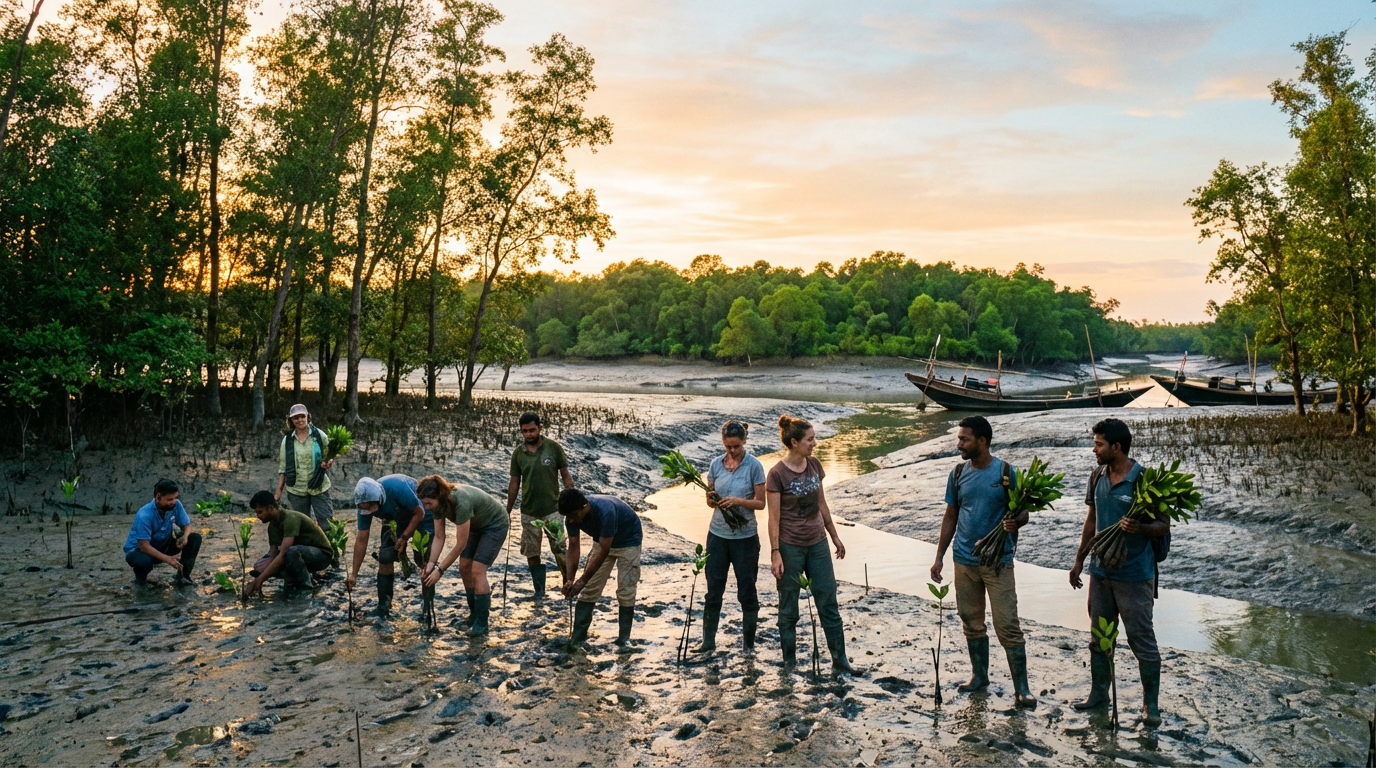
The Sundarbans — a labyrinth of tidal waterways, mudflats, and salt-tolerant mangrove forests spanning over 10,000 square kilometres — stands as the planet’s largest contiguous mangrove ecosystem. Yet rising sea levels, illegal logging, and human-wildlife conflict threaten its survival every single day. Sundarban conservation efforts are no longer optional; they are an urgent race against time to protect a UNESCO World Heritage Site that shelters the iconic Royal Bengal tiger, over 260 bird species, and roughly 4.5 million people whose livelihoods depend on the delta.
In this guide, we break down the most impactful conservation programmes shaping the Sundarbans’ future — from anti-poaching patrols to community-led mangrove restoration — and explain how responsible travellers can contribute simply by choosing eco-friendly tourism.
Why Sundarban Conservation Efforts Matter Now More Than Ever
Between 2001 and 2020, the Sundarbans lost an estimated 137 square kilometres of mangrove cover due to cyclones, coastal erosion, and unauthorised shrimp farming. Cyclone Amphan alone — which struck in May 2020 — damaged nearly 28 per cent of the forest canopy, displacing thousands of families and drowning wildlife corridors under saline floodwater.
Mangroves are not just trees; they are carbon sinks absorbing up to five times more CO₂ than tropical rainforests, natural storm barriers that reduce wave energy by 60–80 per cent, and nursery grounds for commercially valuable fish and crustaceans. Losing the Sundarbans would accelerate climate change, destabilise coastal Bengal, and push the Royal Bengal tiger closer to extinction.
Key Sundarban Conservation Programmes Making a Difference
1. Tiger Protection & Anti-Poaching Patrols
The Sundarban Tiger Reserve, managed by the West Bengal Forest Department, deploys round-the-clock patrol boats equipped with GPS trackers, camera traps, and thermal drones. Since the introduction of the Smart Patrol System in 2018, tiger poaching incidents have dropped by over 70 per cent. The current population stands at an estimated 96 tigers on the Indian side — a number that conservationists are working tirelessly to grow through habitat connectivity corridors and prey-base management.
2. Mangrove Restoration Drives
Community-led nurseries now propagate native species such as Avicennia marina, Sonneratia apetala, and Rhizophora mucronata. Government initiatives like the National Mangrove Mission collaborate with local self-help groups to plant over two million saplings annually along eroded embankments. These newly planted mangrove belts not only restore biodiversity but also protect villages from tidal surges — a win-win that has turned sceptical fishermen into passionate guardians of the forest.
3. Community Livelihood & Alternative Income Models
Poverty is the single biggest driver of illegal resource extraction in the Sundarbans. To address this, NGOs and government bodies fund crab hatcheries, apiculture cooperatives, and eco-tourism homestays that give families a stable income without entering the forest. Eco-tourism alone has generated an estimated ₹150 crore in local revenue over the last five years, channelling money directly into conservation while creating over 8,000 jobs.
How Eco-Tourism Fuels Conservation
Every permit fee, homestay booking, and guided boat safari contributes to the Sundarban Development Board’s conservation fund. Responsible operators — like those listed in our curated Sundarban tour packages — follow strict zero-plastic policies, limit group sizes to minimise disturbance, and employ local naturalists as guides. Choosing a certified eco-tour operator is one of the simplest yet most effective ways you can support Sundarban conservation efforts while enjoying a once-in-a-lifetime wildlife experience.
Travellers who practise responsible travel in the Sundarbans also become ambassadors — sharing stories and images that raise global awareness far beyond what any pamphlet or policy paper can achieve.
Challenges Still Ahead
Despite progress, critical challenges persist. Sea-level rise of roughly 3.14 mm per year threatens to submerge low-lying islands within decades. Human-tiger conflict claims lives on both sides every monsoon season. Illegal prawn-seed collection continues to deplete juvenile fish stocks, and upstream freshwater diversion from the Farakka Barrage increases salinity levels that stress even the hardiest mangrove species. Sustained funding, stricter enforcement, and cross-border cooperation between India and Bangladesh remain essential to long-term success.
Frequently Asked Questions
What are the main threats to the Sundarban mangrove ecosystem?
The primary threats include rising sea levels, cyclone damage, illegal logging, unauthorised shrimp farming, human-wildlife conflict, and upstream freshwater diversion that increases salinity. These combined pressures make coordinated Sundarban conservation efforts critical for the ecosystem’s survival.
How many Royal Bengal tigers live in the Sundarbans?
Current estimates place the population at approximately 96 tigers on the Indian side and around 114 on the Bangladesh side, making the Sundarbans home to the world’s largest single population of mangrove-dwelling tigers.
Can tourists help with Sundarban conservation?
Absolutely. Choosing certified eco-tour operators, following zero-plastic guidelines, respecting wildlife buffer zones, and booking through responsible platforms directly funds conservation through permit fees and community revenue. Explore our curated Sundarban tour packages to travel responsibly.
What is the National Mangrove Mission?
Launched by the Government of India, the National Mangrove Mission aims to restore and protect mangrove habitats across coastal states. In the Sundarbans, it funds community nurseries that plant over two million mangrove saplings each year along vulnerable embankments.
How does mangrove restoration benefit local communities?
Restored mangroves act as natural storm barriers protecting villages from cyclones, serve as nursery grounds for fish and crabs that sustain local fisheries, sequester carbon to combat climate change, and create eco-tourism opportunities that generate stable income for families.
Be Part of the Solution — Explore the Sundarbans Responsibly
The Sundarbans don’t just need policies — they need people who care. Whether you plant a mangrove sapling, choose an eco-certified tour, or simply spread the word, every action counts. Ready to witness this living wonder while supporting its survival?