

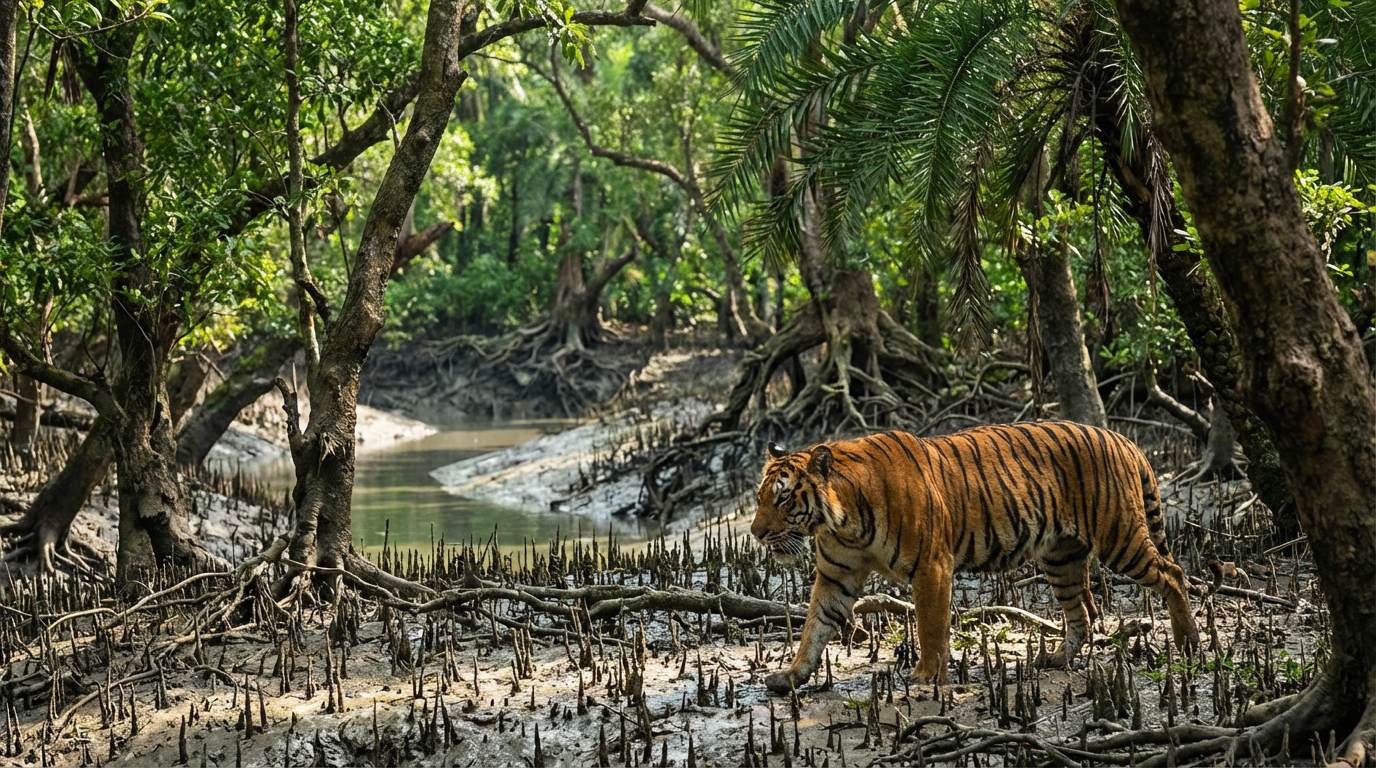
The Royal Bengal Tiger in Sundarban is one of the most iconic wildlife encounters on the planet. Unlike tigers in drier Indian reserves, the Sundarban population has adapted to a tidal mangrove landscape where swimming between islands, hunting in mudflats, and navigating labyrinthine waterways are everyday survival skills. This guide covers everything you need to know — from current population numbers and habitat details to practical safari tips that improve your chances of a sighting.
Royal Bengal Tiger Sundarban — Population and Conservation Status
The Sundarbans straddle India and Bangladesh, forming the largest contiguous mangrove forest on Earth. On the Indian side, the Sundarban Tiger Reserve spans approximately 2,585 square kilometres, of which around 1,700 square kilometres is core tiger habitat. According to the most recent All India Tiger Estimation, the Indian Sundarbans hold an estimated 100 tigers, while the Bangladeshi portion adds roughly 100 more — bringing the combined population to around 200 individuals.
Conservation efforts have intensified over the last two decades. Camera-trap surveys, pugmark tracking, and eDNA sampling from river water help researchers monitor numbers without disturbing the animals. The Sundarban Tiger Reserve is a Project Tiger site and a UNESCO World Heritage area, which means it benefits from dedicated funding, anti-poaching patrols, and controlled tourist access. Village-level eco-development committees around the buffer zone work to reduce human-tiger conflict through awareness programmes, alternative livelihood schemes, and early-warning systems.
If you want to see conservation measures first-hand, our Sundarban wildlife safari itineraries visit watchtowers and interpretation centres inside the reserve.
Habitat and Behaviour — How Sundarban Tigers Are Different
Royal Bengal Tigers in the Sundarbans exhibit behavioural traits rarely seen in other tiger populations. They are excellent swimmers and regularly cross tidal channels several kilometres wide to patrol their territories. Their diet includes spotted deer, wild boar, and — uniquely — fish, crabs, and even monitor lizards. This dietary flexibility is born from the mangrove ecosystem’s rhythmic flooding, which periodically submerges large areas and limits conventional prey access.
The dense mangrove canopy, aerial roots, and shifting mudflats create an environment with almost zero long-range visibility. Tigers here rely on ambush rather than the chase-and-tackle approach common in open grasslands. They are predominantly crepuscular, most active during dawn and dusk, aligning their hunting with tidal cycles that push prey onto exposed banks.
Another notable adaptation is their tolerance of brackish water. Sundarban tigers drink saline or semi-saline water when freshwater is unavailable — a trait researchers continue to study for its physiological implications. To learn more about seasonal patterns and when tiger activity peaks, read our best time to visit Sundarban guide.
Expert Safari Tips for Spotting the Royal Bengal Tiger in Sundarban
Tiger sightings in the Sundarbans are never guaranteed, but following a few informed strategies significantly improves your odds.
Choose the right season. October to March is the peak wildlife window. Cooler temperatures drive tigers toward sunny riverbanks in the morning, making boat-based sightings more likely.
Book a multi-day safari. Single-day trips cover limited ground. A two-night or three-night itinerary lets your boat reach deeper zones such as Netidhopani, Sudhanyakhali, and Dobanki — areas known for higher tiger density.
Stay silent on the boat. Noise carries far across water. Experienced operators cut engines near known corridors and drift silently. Cooperate by keeping voices low and phone sounds off.
Use watchtowers strategically. Forest department watchtowers at Sudhanyakhali and Sajnekhali overlook freshwater ponds where deer congregate — a reliable indicator that a predator may be close.
Carry proper optics. Binoculars in the 8×42 or 10×42 range and a telephoto lens of at least 200 mm will help you spot movement in distant tree lines and capture the moment.
For curated multi-day itineraries designed to maximise wildlife exposure, explore our Sundarban tour packages.