

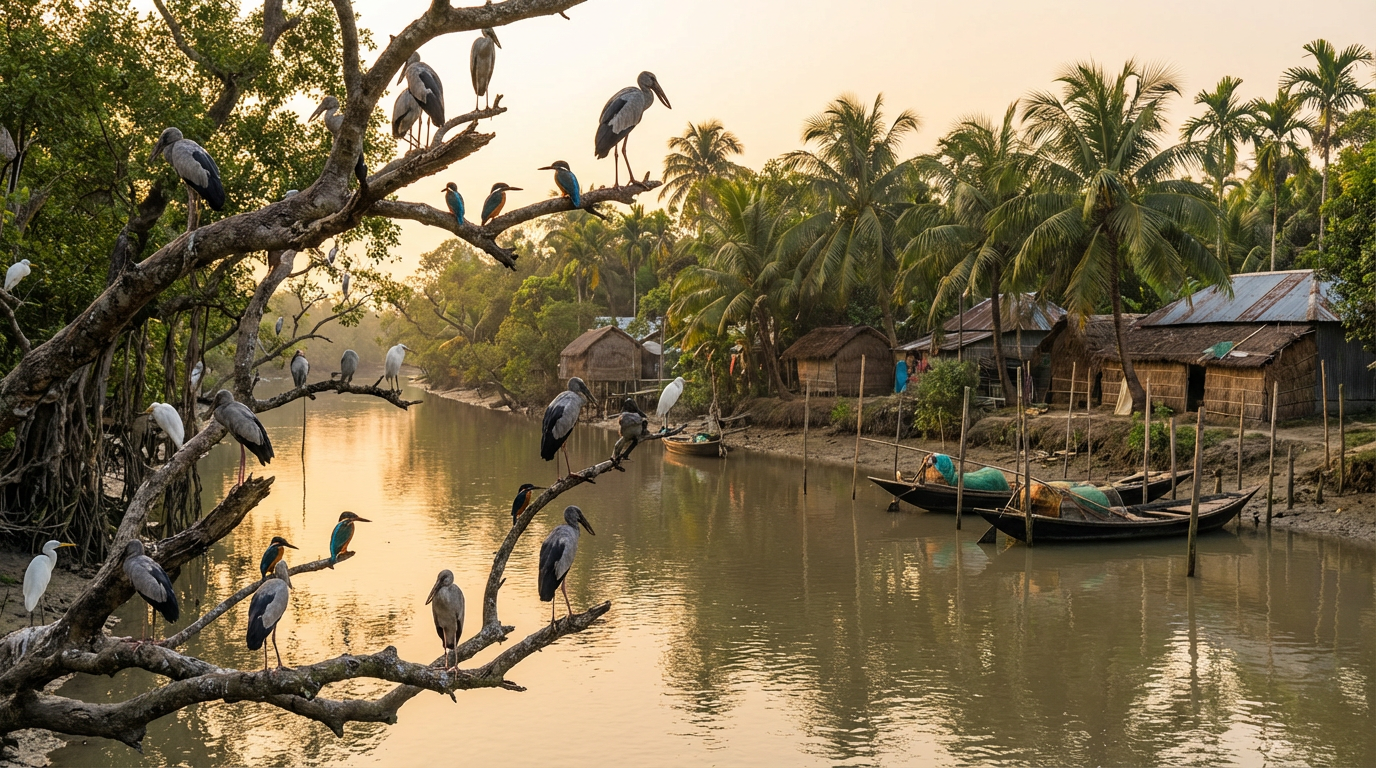
Hidden behind the last motorable road in the Sundarbans, a small village draws thousands of wings every winter. Pakhiralay — literally “the abode of birds” in Bengali — sits on Gosaba Island in South 24 Parganas and has earned a reputation as one of eastern India’s finest birding destinations. If you are planning a Sundarban tour package and care about nature beyond the Royal Bengal Tiger, this village deserves a permanent slot on your itinerary. The open-billed storks that blanket its trees between October and March have turned Pakhiralay Sundarban into a living aviary that rivals any formal bird sanctuary in the state.
Where Is Pakhiralay and How to Get There
Pakhiralay is located on the northern fringe of Gosaba Island, about 100 km south-east of Kolkata. To reach it, travel by road to Canning, continue to Godkhali jetty, and cross by boat to Gosaba. From Gosaba bazaar, Pakhiralay is a 15-minute auto-rickshaw ride or a scenic 4 km walk along the river embankment. Most organised Sundarban tours include a Pakhiralay stop as part of the village exploration segment, so independent logistics are rarely needed. Country boats and mechanised launches ferry passengers from Godkhali to the island throughout the day.
The Birds of Pakhiralay — What You Will See
The star attraction is the Asian open-billed stork. Between late October and early March, colonies numbering several thousand descend on the tall trees surrounding Pakhiralay’s ponds and paddy fields. The storks nest, breed, and feed here before departing at the onset of summer. Beyond the storks, the village and its surrounding wetlands host an impressive checklist that includes little cormorants, grey herons, purple herons, intermediate egrets, white-breasted waterhens, common kingfishers, pied kingfishers, brahminy kites, white-bellied sea eagles, and various species of warblers and flycatchers. During peak migration months, patient observers have logged 80+ species in a single day. Our detailed Sundarban bird watching guide covers species identification tips, gear recommendations, and seasonal calendars to help you prepare.
Eco-Tourism and Village Life at Pakhiralay
Pakhiralay is not just about birds. The village offers a window into authentic Sundarban rural life. Farming, fishing, and crab collection form the economic backbone. Many households have embraced eco-tourism — offering homestays, cooking traditional Bengali meals for visitors, and guiding boat trips through the narrow creeks. A morning spent at Pakhiralay typically includes a country-boat ride along mangrove-lined channels, an embankment walk past fish ponds and rice paddies, and an extended birdwatching session near the nesting trees. Several eco-resorts have opened in and around Pakhiralay, providing basic but clean accommodation with local cuisine — a welcome alternative to the larger houseboat-based tours.
Best Time to Visit Pakhiralay Sundarban
The optimal birding window is December to February, when stork colonies peak and migratory species from Central Asia are present in large numbers. October–November marks the arrival phase, and March signals departures. For general sightseeing and pleasant weather, the broader October to March season works well — temperatures stay between 15 °C and 28 °C, humidity is manageable, and river conditions favour comfortable boat travel. Avoid June through September; monsoon rains cause waterlogging, and bird activity drops significantly. If you combine a Pakhiralay visit with a jungle safari to Sajnekhali or Sudhanyakhali, a 2-night / 3-day package covers both comfortably.
How to Include Pakhiralay in Your Sundarban Itinerary
Most Sundarban tour packages of 2 nights or longer already include a Pakhiralay visit on the first or last day, combined with the Gosaba Island village tour. If your package does not mention it, request a Pakhiralay add-on — the detour requires no extra permit and adds roughly 2–3 hours. For serious birders, a dedicated morning session starting at sunrise (around 5:30 AM in winter) yields the best sightings. Carry binoculars, a telephoto lens, and a field guide. Keep noise to a minimum near nesting trees — storks are habituated to human presence but will flush if approached too aggressively.
Frequently Asked Questions
Is Pakhiralay inside the Sundarban Tiger Reserve?
No. Pakhiralay is a civilian village on Gosaba Island, outside the tiger reserve boundary. No forest entry permit is needed to visit Pakhiralay itself — it is freely accessible as part of the inhabited delta.
How many bird species can be seen at Pakhiralay?
Over 100 species have been recorded in and around Pakhiralay across the year. During the peak winter season (December–February), a single-day count of 80+ species is achievable with experienced guidance and early-morning effort.
Are there eco-resorts or homestays at Pakhiralay?
Yes. Several locally run eco-resorts and family homestays operate at Pakhiralay, offering clean rooms, Bengali home-cooked meals, and guided birdwatching trips. Advance booking through a Sundarban tour operator is recommended during peak season.
Can I visit Pakhiralay as a day trip from Kolkata?
A same-day return is technically possible but exhausting. The journey from Kolkata to Pakhiralay takes 4–5 hours each way, leaving very little time for actual birding. A minimum 1-night stay on Gosaba Island is strongly recommended.
What is the best month to photograph storks at Pakhiralay?
January is considered the best month. The stork colonies are at their largest, chicks are visible in nests, and morning light conditions are ideal for photography. December and February are also excellent alternatives.