

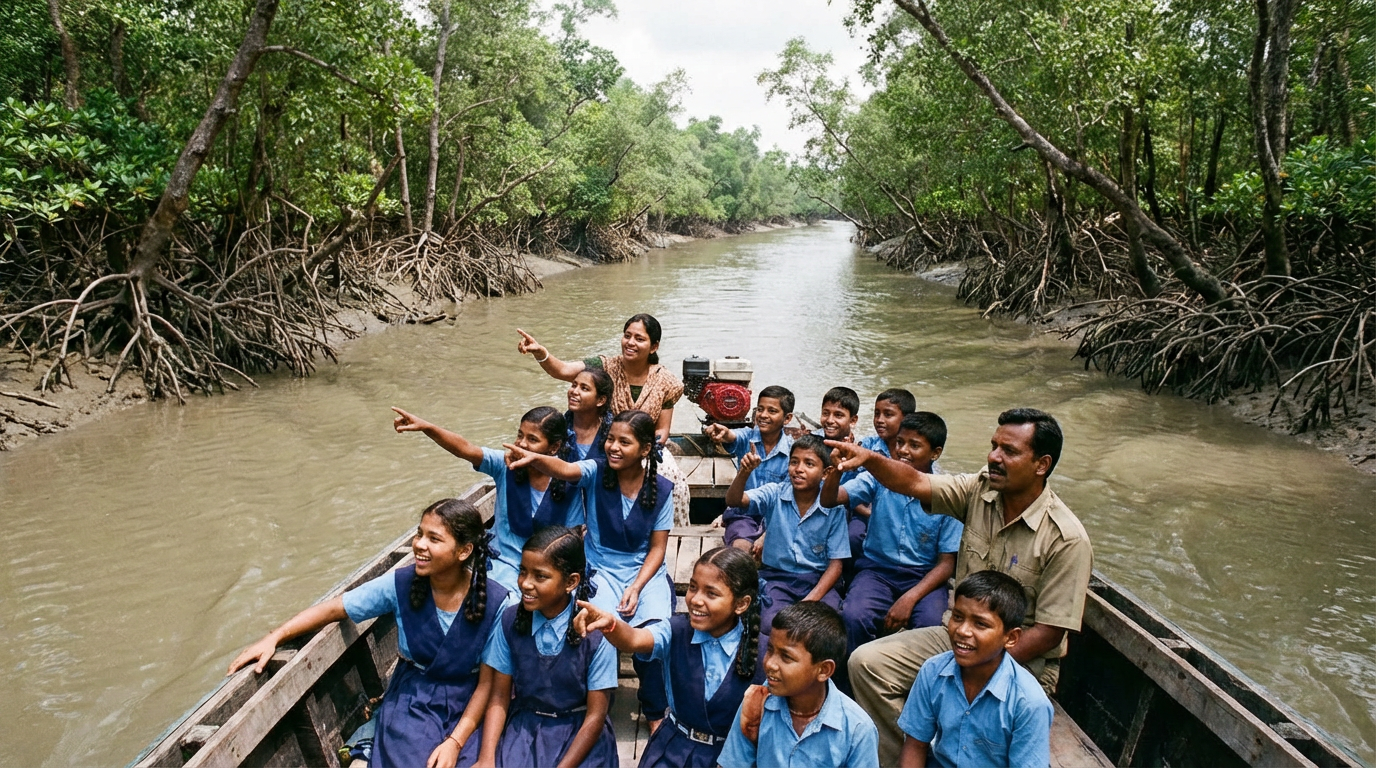
Most school excursions follow the same script — a museum, a factory tour, or a heritage monument. But a Sundarban school trip package takes students out of textbooks and into a living ecosystem where geography, biology, and environmental science unfold before their eyes. The Sundarbans, the world’s largest tidal mangrove forest and a UNESCO World Heritage Site, offers a rare outdoor classroom where students witness mangrove root systems, tidal dynamics, and Royal Bengal Tiger habitats in their natural context. For schools in Kolkata, West Bengal, and neighbouring states, a guided educational tour to the Sundarbans is now one of the most impactful field trips a school can organise. With safe group accommodation, dedicated naturalist guides, and special student rates, Sundarban Ecofriends makes it easy for teachers and administrators to plan a trip that students remember long after the school year ends.
Why Schools Choose the Sundarbans for Educational Tours
The Sundarbans is not just a wildlife destination — it is a multi-disciplinary outdoor laboratory. Here is why leading schools across Eastern India are choosing a Sundarban school trip package for their annual excursion:
- Living Geography Lessons: Students observe tidal river systems, deltaic landforms, and coastal erosion patterns that they normally study only in textbooks.
- Ecology and Environmental Science: The mangrove ecosystem teaches nutrient cycling, halophyte adaptation, and the critical role of wetlands as carbon sinks and storm buffers.
- Wildlife Observation: From the Sajnekhali and Sudhanyakhali watchtowers, students can spot Gangetic dolphins, water monitors, mudskippers, kingfishers, and — with luck — the Royal Bengal Tiger.
- Conservation Awareness: Guided discussions at the Mangrove Interpretation Centre and Sajnekhali Museum help students understand human-wildlife conflict, climate change threats, and forest protection measures.
- Team Building: Boat rides, nature walks, and group activities on the islands foster teamwork, leadership, and communication skills among students.
A well-planned Sundarban school trip transforms routine syllabus topics into lived experiences. Schools looking for group pricing and logistics support should also explore our Sundarban group tour package deals designed for large parties.
What a Sundarban School Trip Package Includes
A comprehensive Sundarban school trip package from Sundarban Ecofriends covers every detail so that teachers can focus on the educational experience rather than logistics:
- AC/Non-AC Vehicle Transfers — pickup from school or a central Kolkata meeting point, with transport to Godkhali Jetty and return.
- Motorised Boat Safari — a dedicated boat with life jackets for the entire group, covering key watchtowers and creeks inside the Sundarban Tiger Reserve.
- Naturalist Guide — an experienced, English-and-Bengali speaking guide who explains the ecology, geography, and wildlife in an age-appropriate manner.
- Group Accommodation — dormitory-style or multi-bed rooms in safe, fenced eco-lodges on inhabited islands, with attached bathrooms and 24-hour caretaker presence.
- All Meals — vegetarian and non-vegetarian Bengali meals including lunch, dinner, and breakfast, with drinking water and snacks on the boat.
- Forest Entry Permits — all government permissions, guide fees, camera fees, and reserve entry tickets included in the package price.
Pricing for a 2-night / 3-day Sundarban school trip package typically starts at ₹3,500–₹4,500 per student for groups of 30 or more, with complimentary seats for accompanying teachers. Smaller groups and day trips are available on request. Browse the full range on our Sundarban tour packages page.
Safety Measures and Group Accommodation Standards
Parent confidence is the foundation of every successful school excursion. Sundarban Ecofriends applies strict safety protocols for all student groups:
- Licensed Boats with Life Jackets: Every student and teacher receives a properly fitted life jacket before boarding. Boats carry first-aid kits, fire extinguishers, and a satellite phone for emergencies.
- Fenced Eco-Lodge Campuses: Accommodation compounds are fenced and gated, located on inhabited islands well outside the core tiger reserve. Staff patrol the property after dark.
- Teacher-to-Student Ratio: We recommend and support a minimum 1:10 teacher-to-student ratio. Our guides act as additional supervisors during safari and nature walks.
- Medical Preparedness: The nearest primary health centre is reachable by boat within 30–60 minutes. Our team carries a comprehensive first-aid kit, and one staff member on each trip holds a basic first-aid certification.
- Emergency Communication: Despite limited mobile coverage, our boats carry VHF radio sets and a satellite phone for instant contact with the forest department and local authorities.
For more detailed guidance, teachers and parents can review our Sundarban tour safety tips guide before confirming the trip.
How to Book a Sundarban School Trip
Booking a Sundarban school trip package is simple. Contact Sundarban Ecofriends via WhatsApp or the website with your preferred dates, student count, and accommodation preferences. Our team will send a customised itinerary and quotation within 24 hours. We offer flexible payment plans for schools — a 30 % advance secures the booking, with the balance due one week before departure. Customisation options include adding a photography workshop, a mangrove plantation activity for students, or extending the trip by a day for deeper wildlife observation. Early booking — at least 45 days in advance — is recommended during the peak season (October–March) to ensure vessel and lodge availability for large groups.
Frequently Asked Questions
What is the ideal age group for a Sundarban school trip?
Students from Class 5 (age 10) and above benefit most from the educational content. Younger children can participate in shorter day-trip versions. The naturalist guide adjusts explanations to suit the age group.
How many students can be accommodated in one trip?
Sundarban Ecofriends can handle groups of 20 to 120 students per trip. For very large groups, we deploy multiple boats and distribute accommodation across partner lodges on the same island to keep everyone together.
Is the Sundarban school trip safe for children?
Yes. Students stay on inhabited islands outside the core tiger reserve. All boats carry life jackets and first-aid kits, accommodation is in fenced eco-lodges with 24-hour caretaker staff, and guides maintain headcounts at every transition point.
What subjects does the educational tour cover?
The trip covers geography (tidal rivers, deltaic landforms), biology (mangrove ecology, wildlife), environmental science (carbon sinks, climate change), and general awareness (conservation, local culture). Teachers can request subject-specific focus areas in advance.
What is the cost of a Sundarban school trip package?
A 2-night / 3-day package for groups of 30 or more starts at approximately ₹3,500–₹4,500 per student. This includes transport, accommodation, meals, boat safari, naturalist guide, and all forest permits. Accompanying teachers receive complimentary seats.