

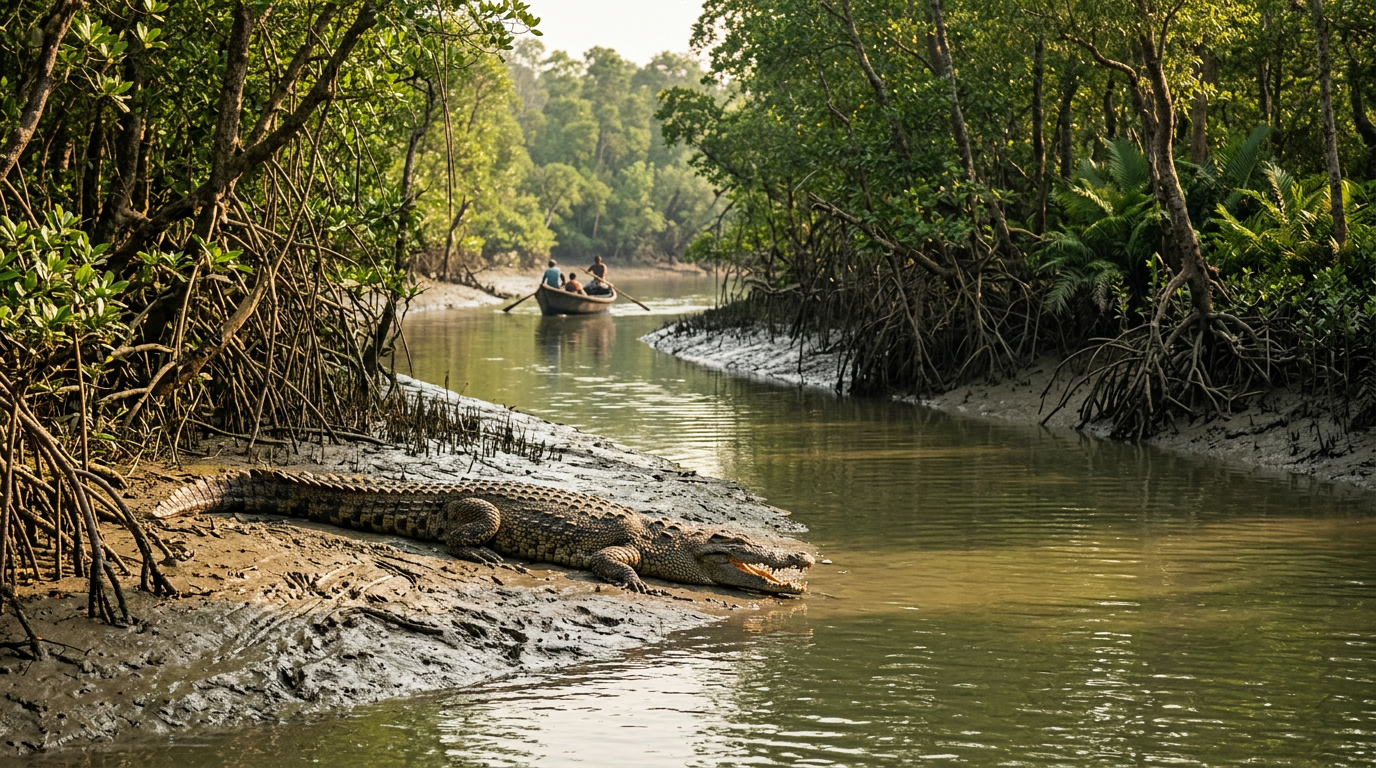
India is home to two world-class mangrove ecosystems — the Sundarbans in West Bengal and Bhitarkanika National Park in Odisha. Both protect endangered wildlife, shelter massive saltwater crocodiles, and offer unforgettable boat safaris through labyrinthine tidal creeks. Yet they differ sharply in size, flagship species, visitor experience, and cost. This Sundarban vs Bhitarkanika comparison puts every key factor side by side so you can choose the mangrove adventure that fits your 2026 travel plans.
Geography and Mangrove Coverage
The Sundarbans straddle the India–Bangladesh border at the mouth of the Ganges–Brahmaputra delta, forming the largest contiguous mangrove forest on Earth — roughly 10,000 km² in total, with about 4,260 km² on the Indian side. Bhitarkanika, located at the delta of the Brahmani and Baitarani rivers in Kendrapara district, covers a more compact 672 km² including its wildlife sanctuary buffer. While Sundarban’s sheer scale can feel overwhelming, Bhitarkanika’s smaller footprint means denser wildlife sightings per kilometre of creek.
Both parks feature classic mangrove species — Sundari, Gewa, Keora — but Bhitarkanika also borders Gahirmatha Beach, famous as an Olive Ridley turtle nesting ground.
Wildlife: Tigers, Crocodiles, and More
The Sundarbans’ undisputed star is the Royal Bengal Tiger. Roughly 100 tigers patrol these mangrove islands, and they are uniquely adapted swimmers. Bhitarkanika has no tigers at all — its apex predator is the saltwater crocodile. The park protects over 1,700 estuarine crocodiles, including individuals exceeding 6 metres, making it India’s premier crocodile habitat.
That said, the Sundarbans also harbour a healthy crocodile population, along with Gangetic dolphins, water monitors, and over 300 bird species. Bhitarkanika counters with king cobras, Indian pythons, eight species of kingfisher, and the spectacular winter congregation of bar-headed geese. Both parks are birding paradises — pack your binoculars regardless of which you choose.
Sundarban vs Bhitarkanika — Feature Comparison Table
| Feature | Sundarban (West Bengal) | Bhitarkanika (Odisha) |
|---|---|---|
| Total Mangrove Area | ~4,260 km² (Indian side) | ~672 km² |
| UNESCO Status | World Heritage Site (1987) | Ramsar Wetland (2002) |
| Flagship Species | Royal Bengal Tiger | Saltwater Crocodile |
| Crocodile Population | ~200 estuarine crocs | ~1,700+ estuarine crocs |
| Boat Safari Duration | Full-day / multi-day houseboats | 2–4 hour motorboat rides |
| Best Season | October – March | November – March |
| Nearest City | Kolkata (100 km) | Bhubaneswar (150 km) |
| Avg 2-Night Trip Cost | ₹4,500 – ₹9,000 per person | ₹3,000 – ₹6,500 per person |
| Turtle Nesting | No | Yes — Olive Ridley at Gahirmatha |
| Tiger Sighting Chance | Low but possible | None (no tigers) |
Boat Safaris and Visitor Experience
Sundarban safaris typically span two to three days aboard motorised launches or houseboats. You glide past Sajnekhali, Sudhanyakhali, and Dobanki watchtowers, scanning mudflats for pugmarks and crocodile snouts. The multi-day format means deeper immersion but also higher costs.
Bhitarkanika’s boat rides are shorter — usually two to four hours along Khola and Bhitarkanika creek loops — yet the crocodile density is so high that spotting a dozen individuals in a single trip is routine. The park also offers walking trails through mangrove boardwalks, something the Sundarbans largely lack. For travellers short on time, Bhitarkanika delivers a punchy wildlife hit in a single day.
Trip Costs and Accessibility in 2026
A typical 2-night Sundarban group tour from Kolkata ranges from ₹4,500 to ₹9,000 per person, covering transport, accommodation on a launch, meals, and forest permits. Premium private houseboats push the budget past ₹12,000. Check out our curated Sundarban tour packages for the best 2026 deals.
Bhitarkanika is generally 20–30 % cheaper. Entry permits are modest (₹40 for Indians), and boat hire for a group of four costs around ₹2,000–₹3,500. Accommodation in Dangmal or Chandbali is budget-friendly, with forest rest houses starting at ₹800 per night. The trade-off is less polished tourism infrastructure compared to the Sundarbans’ well-established operator network.
Which Mangrove Park Should You Visit?
Choose Sundarban if: you dream of tiger territory, want an immersive multi-day houseboat experience, and plan to combine the trip with Kolkata sightseeing. The Sundarbans’ UNESCO heritage status and larger ecosystem make it a bucket-list destination.
Choose Bhitarkanika if: you are a reptile or birding enthusiast, prefer a quicker day-trip format, want to witness Olive Ridley mass nesting (January–March), or travel on a tighter budget. It pairs well with Puri and Konark on an Odisha circuit.
Ideally, visit both — they complement rather than compete, showcasing different faces of India’s mangrove heritage.
Frequently Asked Questions
Is Bhitarkanika bigger than the Sundarbans?
No. The Sundarbans cover roughly 4,260 km² on the Indian side alone, making them about six times larger than Bhitarkanika’s 672 km². However, Bhitarkanika’s compact size leads to denser wildlife sightings per trip.
Can you see tigers in Bhitarkanika?
No. Bhitarkanika has no tiger population. If spotting a Royal Bengal Tiger is on your wish list, the Sundarbans is the only mangrove park in India where that is possible.
Which park has more crocodiles — Sundarban or Bhitarkanika?
Bhitarkanika has a significantly larger saltwater crocodile population — over 1,700 individuals compared to around 200 in the Sundarbans. It is India’s top destination for crocodile sightings.
What is the best time to visit both parks?
October to March works for the Sundarbans; November to March is ideal for Bhitarkanika. Avoid the monsoon months (June–September) when heavy rainfall and cyclone risks make both parks inaccessible.
How much does a Sundarban tour cost compared to Bhitarkanika?
A 2-night Sundarban group tour typically costs ₹4,500–₹9,000 per person from Kolkata. A comparable Bhitarkanika trip runs about 20–30 % cheaper, with entry permits and boat hire costing significantly less.