

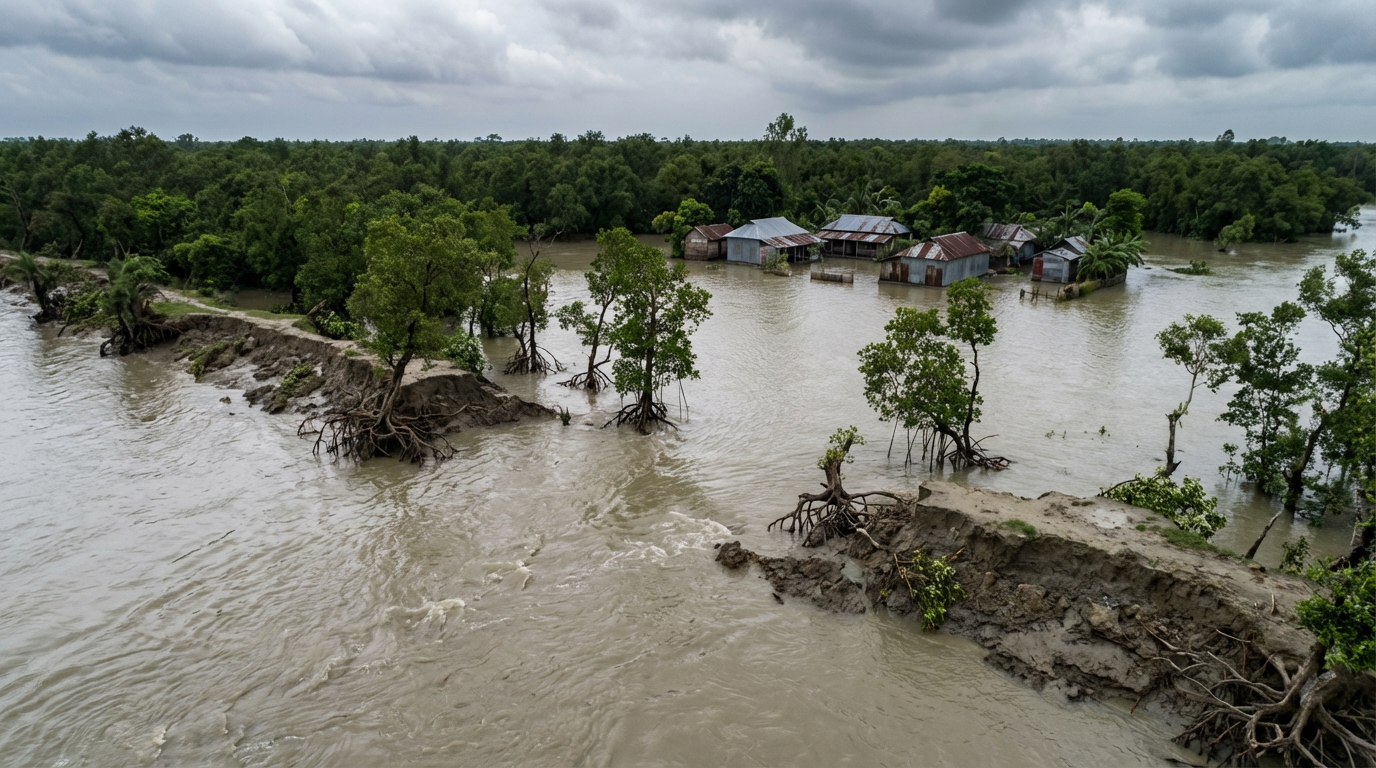
The Sundarban — the world’s largest mangrove delta straddling India and Bangladesh — stands on the frontline of a planetary crisis. Climate change impact on Sundarban is no longer a distant forecast; it is unfolding right now. Rising sea levels, intensifying cyclones, and creeping salinity are reshaping every island, every waterway, and every life that depends on this UNESCO World Heritage Site. In this guide we unpack the science, map the damage, and explore what responsible travellers and conservationists can do before it is too late.
Rising Sea Levels — The Slow Drowning of Sundarban Islands
Global mean sea levels have risen roughly 3.6 mm per year since 2006, but in the Bay of Bengal the rate is even steeper. Satellite data published by the School of Oceanographic Studies, Jadavpur University, shows that Sundarban’s tide gauges record an annual rise of nearly 8 mm — more than double the global average. Over the past three decades, at least four inhabited islands — Lohachara, Suparibhanga, Bedford, and Kabasgadi — have vanished beneath the waterline entirely.
This is not gradual erosion alone. Each high tide now pushes saltwater further inland, saturating soil that once supported paddy cultivation. Families who have farmed the same plots for generations find their harvests failing. The climate change impact on Sundarban agriculture drives migration toward Kolkata’s urban fringes, creating a chain reaction of social displacement that mirrors ecological collapse.
Understanding the importance of Sundarban mangroves as a natural sea wall makes the gravity of this loss unmistakable — every hectare of mangrove lost accelerates the flooding of the next village.
Shrinking Mangroves and the Salinity Crisis
Mangroves are the delta’s immune system. Their dense root networks trap sediment, buffer storm surges, and sequester up to five times more carbon per hectare than terrestrial forests. Yet between 1990 and 2020, the Indian Sundarban lost an estimated 5.5 % of its mangrove cover according to the Forest Survey of India.
Salinity intrusion is one of the primary killers. As sea levels climb, saline water pushes deeper into freshwater channels. Species like Heritiera fomes (Sundari tree — after which the forest is named) are salt-sensitive; large tracts are dying from the roots up. The irony is brutal: the very tree that gave Sundarban its identity is being erased by the changing chemistry of its own water.
Compounding the problem are more frequent and fiercer cyclones — Amphan (2020), Yaas (2021), and Remal (2024) each uprooted thousands of mangroves in hours, stripping away protective cover that took decades to grow. Post-cyclone surveys confirm that recovery rates are slowing because saline soils inhibit new seedling establishment.
Wildlife Displacement — Tigers, Dolphins, and Beyond
The Royal Bengal Tiger is Sundarban’s flagship species, yet shrinking territory is pushing these apex predators into closer contact with human settlements. The National Tiger Conservation Authority estimates roughly 96 tigers in the Indian Sundarban; as islands submerge and prey habitats shrink, human-tiger conflict incidents have increased by over 30 % in the last decade.
Gangetic dolphins, estuarine crocodiles, and migratory bird populations face parallel stress. Changing salinity alters fish breeding cycles, collapsing the food web from the bottom up. Mud-flat species that shorebirds depend on during winter migrations are declining, jeopardising flyway connectivity from Siberia to the Bay of Bengal.
Ongoing Sundarban conservation efforts — including mangrove replanting corridors and anti-poaching patrols — are critical, but they operate in a race against accelerating environmental degradation.
What Scientists Predict — And What You Can Do
IPCC projections under a moderate-emission scenario (SSP2-4.5) suggest that by 2100 the Bay of Bengal could rise by 44–76 cm. For a low-lying delta averaging barely 2 metres above current sea level, that would inundate up to 17 % of India’s Sundarban. The window for meaningful intervention is narrowing fast.
Concrete steps matter. Supporting community-based mangrove nurseries, choosing eco-certified tourism operators, and amplifying local voices in climate policy discussions all contribute to resilience. Responsible tourism funnels revenue directly into conservation — every visitor who opts for an eco-friendly Sundarban tour package helps fund habitat protection, livelihood programmes, and scientific monitoring.
If you have been considering a trip to witness this extraordinary ecosystem, now is the time — not as disaster tourism, but as an act of solidarity with the communities fighting to hold their ground against a rising sea.
Frequently Asked Questions
How does climate change impact Sundarban’s mangrove forests?
Rising sea levels increase salinity in freshwater channels, killing salt-sensitive species like the Sundari tree. Stronger cyclones uproot mature mangroves faster than they can regenerate, causing a net loss of forest cover and weakening the delta’s natural storm defence.
Which Sundarban islands have already been submerged due to sea-level rise?
At least four islands — Lohachara, Suparibhanga, Bedford, and Kabasgadi — have been fully submerged. Several more, including Ghoramara and Mousuni, are losing landmass every year and face partial submergence within the next two decades.
Is the Royal Bengal Tiger threatened by climate change in Sundarban?
Yes. Shrinking island habitats and reduced prey availability are pushing tigers closer to human settlements, increasing conflict. Studies project that without intervention, suitable tiger habitat in the Indian Sundarban could decline by 96 % by 2070 under high-emission scenarios.
Can mangrove replanting reverse the damage caused by climate change?
Replanting helps but cannot fully reverse the damage on its own. It must be combined with global emission reductions, salinity management, and community livelihood support to create lasting resilience in the Sundarban ecosystem.
How can tourists help protect Sundarban from climate change effects?
Visitors can choose eco-certified tour operators, avoid single-use plastics, support local conservation initiatives financially, and spread awareness. Revenue from responsible eco-tourism funds mangrove nurseries, anti-poaching patrols, and scientific monitoring programmes.
Take Action — Visit Sundarban Responsibly
Ready to witness the Sundarban before it changes forever? Travel with purpose and support conservation on the ground.