

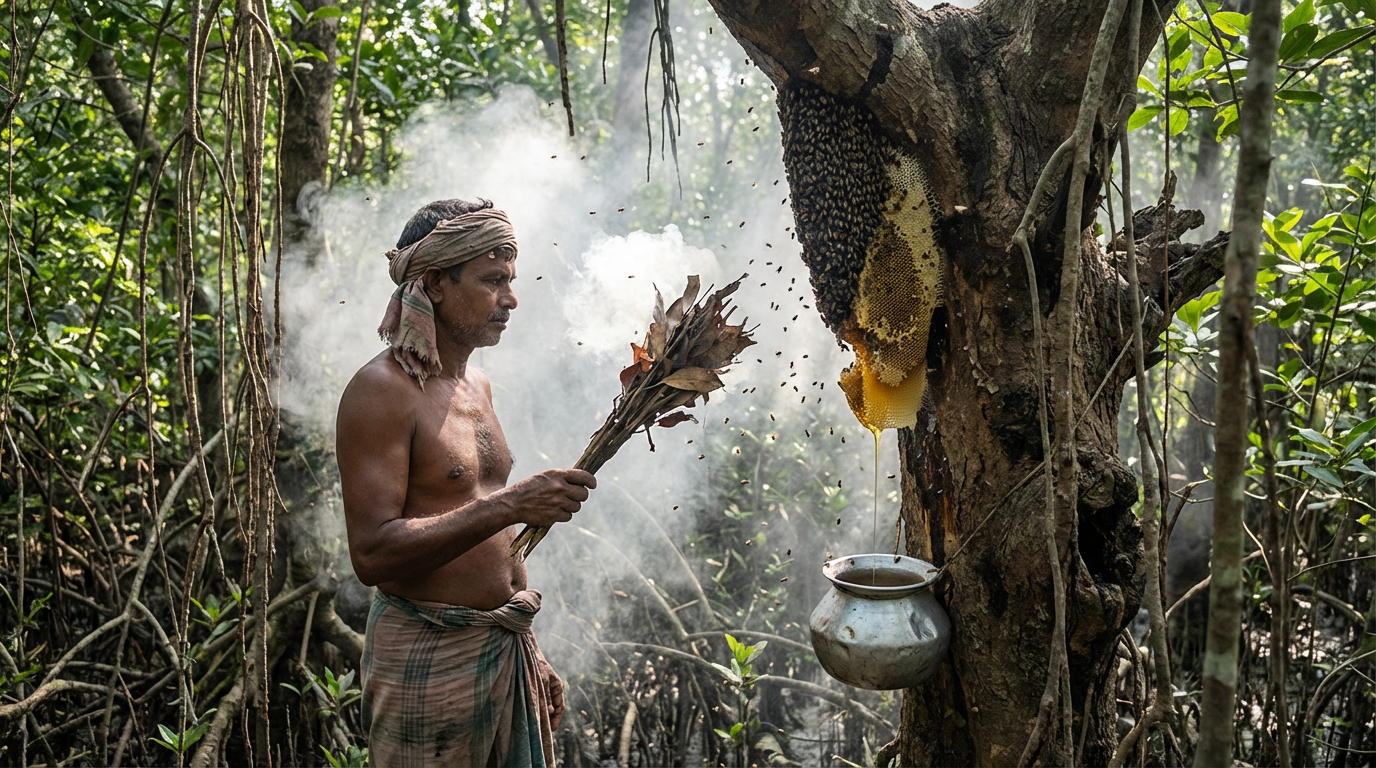
Few experiences in India match the raw intensity of a Sundarban honey collection tour. Every year between April and June, small groups of men known as moulis wade into the tidal mangrove forest armed with nothing but a bundle of dried leaves, a clay pot, and generations of inherited knowledge. They track wild honeybee colonies by reading bark stains and flight patterns, then smoke the bees into temporary calm and cut dripping combs from tree trunks — exactly as their ancestors did centuries ago. Watching this process firsthand is a cultural and sensory encounter that no wildlife safari can replicate.
Who Are the Moulis — Sundarban’s Traditional Honey Collectors?
The word mouli (sometimes spelt mawali) refers to the hereditary honey gatherers of the Sundarbans delta. These men belong to marginalised fishing and forest-dwelling communities that have depended on wild honey, beeswax, and fish for survival for hundreds of years. Before entering the forest, every mouli performs a ritual prayer to Bonbibi, the guardian goddess of the Sundarbans. They believe that only those who take with gratitude — and never with greed — will return safely. To learn more about this powerful tradition, read our Bonbibi Temple guide.
Moulis work in teams of five to eight, navigating narrow creeks in flat-bottomed wooden boats called bhotbhoti. One person stays in the boat as lookout — tigers are a genuine threat in the collection zones. The rest move silently through knee-deep mud, scanning for bee clusters on Sundari, Gewa, and Khalsi trees. Their ability to locate hives in dense canopy, often 20 feet overhead, is a skill learned from childhood and passed from father to son.
How Wild Honey Is Harvested in the Sundarbans
The collection technique has remained virtually unchanged for generations. Once a hive is spotted, the lead mouli lights a torch of dried hental palm leaves. Thick white smoke drifts upward, confusing the bees’ communication and triggering them to gorge on honey in preparation to flee. Within minutes, thousands of bees lift off the comb in a buzzing cloud. The mouli climbs the tree — barefoot, without a harness — and slices away roughly two-thirds of the comb using a curved dao blade, leaving the remaining third intact so the colony can regenerate. This sustainable practice, enforced by both tradition and Forest Department regulation, ensures that bee populations recover each season.
The harvested comb is dropped into aluminium or clay pots below, where other team members squeeze the honey through cloth and seal the containers. On a good day, a team of moulis can collect 15–20 kilograms of raw, unprocessed forest honey — dark amber, intensely floral, and prized across Bengal. During a Sundarban local village tour, you can often buy this honey directly from collector families at a fraction of the market price.
What to Expect on a Sundarban Honey Collection Tour
A dedicated Sundarban honey collection tour typically runs between April and mid-June — the narrow window when bee activity peaks and the Forest Department issues collection permits. Tour operators arrange boat excursions to the peripheral zones where moulis are actively harvesting. Expect an early-morning departure (5:30–6:00 AM), a 60–90 minute boat ride through mangrove channels, and then one to two hours observing the collection at a respectful distance.
The atmosphere is unforgettable: smoke curling through the canopy, the deep hum of disturbed bees, the smell of warm beeswax, and the sight of golden honey streaming into weathered pots. Your guide will explain the rituals, the ecological reasoning behind partial harvesting, and the economic realities faced by mouli families. Most tours end with a tasting session — fresh comb straight from the forest, paired with local snacks on the boat. If you want to combine this with a full itinerary, browse our Sundarban tour packages that include honey-collection add-ons.
Practical Tips for Visitors
- Season: April to mid-June only. Outside this window, moulis are not in the forest and the experience cannot be arranged.
- What to wear: Long sleeves, closed shoes, and a hat. Bee stings are rare during a guided tour but possible if you approach too closely.
- Keep distance: Stay at least 10–15 metres from the active hive. Your guide will set the boundary.
- Photography: Ask permission before photographing moulis. Most are happy to be captured at work, but respect is non-negotiable.
- Buy directly: Purchase honey from the moulis themselves. Prices range from ₹400–₹600 per kilogram — far cheaper than Kolkata shops — and the money goes directly to the collector’s family.
Frequently Asked Questions
When is the best time for a Sundarban honey collection tour?
The honey collection season runs from April to mid-June. This is when the Forest Department issues permits and moulis are actively harvesting wild honey in the mangrove forest.
Is it safe to watch moulis collect honey in the Sundarbans?
Yes. Guided tours maintain a safe distance of 10–15 metres from the hive. The smoke used by moulis calms the bees effectively, and stings during observation are extremely rare.
Can I buy Sundarban wild honey directly from the moulis?
Absolutely. Most moulis sell fresh raw honey at ₹400–₹600 per kilogram. Buying directly supports their families and guarantees unprocessed, pure forest honey.
Do moulis kill the bees during honey collection?
No. Traditional moulis harvest only about two-thirds of the comb and leave the rest intact so the bee colony can regenerate. This sustainable method is enforced by both custom and Forest Department rules.
How do I book a honey collection tour in the Sundarbans?
Contact a licensed Sundarban tour operator and request a honey-collection itinerary during the April–June season. Sundarban Ecofriends offers guided packages that include boat transport, a local guide, and a mouli interaction session.