

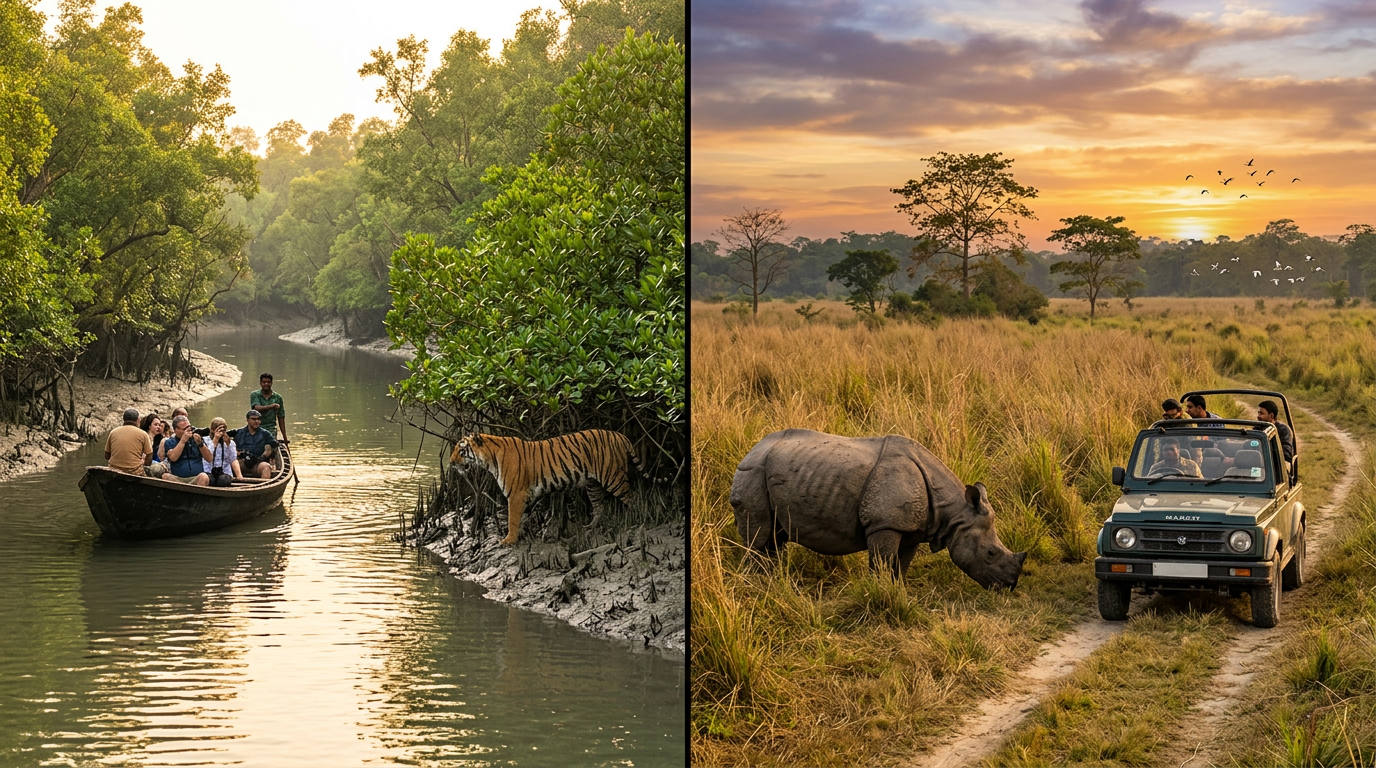
India is home to some of the most thrilling wildlife destinations on the planet, and two names consistently top every traveller’s list — the Sundarbans and Kaziranga. One offers silent boat safaris through tidal mangrove forests where the Royal Bengal Tiger rules the waterways; the other puts you in an open jeep across vast grasslands where the one-horned Indian rhinoceros roams freely. So, Sundarban vs Kaziranga — which wildlife safari should you choose in 2026? This detailed comparison covers everything from safari style and star wildlife to budget, best season, and overall experience.
Safari Style — Boat vs Jeep
The most striking difference in the Sundarban vs Kaziranga debate is the safari format itself. In the Sundarbans, you explore exclusively by motorised boat or country boat, gliding through narrow creeks flanked by dense mangrove canopy. The silence is profound — broken only by birdsong and the occasional splash of a saltwater crocodile. This Sundarban wildlife safari experience is unlike anything else in India.
Kaziranga, by contrast, offers classic jeep safaris across four ranges — Central, Western, Eastern, and Burapahar. You ride through tall elephant grass, marshlands, and scattered tropical forests. Elephant-back safaris were once popular here but have been restricted in recent years. The open-jeep format gives excellent elevated sightlines across the flat terrain.
Star Wildlife — Tigers vs Rhinos
The Sundarbans hold the world’s largest population of mangrove-dwelling Royal Bengal Tigers. Spotting one is rare and exhilarating — these tigers swim between islands and are adapted to a semi-aquatic life. Beyond tigers, you’ll encounter spotted deer, wild boar, water monitors, Gangetic dolphins, and over 300 bird species.
Kaziranga is the stronghold of the Indian one-horned rhinoceros, hosting roughly two-thirds of the world’s population. Rhino sightings are almost guaranteed. The park also shelters wild elephants, wild water buffalo, swamp deer, hoolock gibbons, and is one of the highest tiger-density zones in India — though tall grass makes tiger sightings uncommon.
Sundarban vs Kaziranga — Head-to-Head Comparison
| Feature | Sundarbans | Kaziranga |
|---|---|---|
| Location | West Bengal (Ganges delta) | Assam (Brahmaputra floodplain) |
| UNESCO Status | World Heritage Site (1987) | World Heritage Site (1985) |
| Safari Type | Boat safari | Jeep & elephant safari |
| Star Animal | Royal Bengal Tiger | One-horned Indian Rhinoceros |
| Landscape | Tidal mangrove forests & rivers | Grasslands, wetlands & tropical forest |
| Best Season | October – March | November – April |
| Nearest City | Kolkata (≈ 100 km) | Guwahati (≈ 220 km) |
| Trip Duration | 2–3 days (overnight boat) | 2–3 days (lodge-based) |
| Budget (approx.) | ₹4,500 – ₹12,000/person | ₹6,000 – ₹15,000/person |
| Crowd Level | Moderate | High (peak season) |
Best Time to Visit & Accessibility
The Sundarbans are open year-round, but the sweet spot is October to March when weather is pleasant and wildlife gathers near freshwater sources. Kolkata serves as the gateway — a short 2-hour drive or boat ride from Godkhali jetty gets you into the reserve.
Kaziranga opens from November to April (closed during monsoon floods). Guwahati is the nearest airport; Jorhat and Furkating are closer rail options. Driving from Guwahati takes about 4–5 hours. Peak crowds hit during December–February, so plan mid-week visits for a quieter experience.
Which Safari Should You Choose?
If you crave a raw, offbeat adventure — sleeping on a boat, exploring tidal creeks at dawn, and chasing the thrill of a tiger sighting in the mangroves — the Sundarbans will leave you speechless. Browse our Sundarban tour packages for curated 2- and 3-day itineraries that include boat safari, forest permits, and meals.
If you want guaranteed big-mammal sightings, open-grassland photography, and a more structured park experience, Kaziranga is the safer bet — especially for first-time safari-goers.
Honestly? Serious wildlife lovers should do both. They’re complementary experiences — water vs land, stealth vs spectacle, mangrove vs grassland. Together, they paint the full picture of India’s extraordinary biodiversity.
Frequently Asked Questions
Is Sundarban better than Kaziranga for wildlife photography?
It depends on your subject. Kaziranga offers easier, close-range rhino and elephant shots in open grasslands. The Sundarbans demand patience but reward you with unique mangrove-framed compositions and rare tiger-on-water shots.
Can I visit both Sundarban and Kaziranga in one trip?
Yes. Fly Kolkata → Guwahati (≈ 2 hours). Spend 2–3 days in the Sundarbans first, then fly to Assam for 2–3 days in Kaziranga. A combined trip of 6–7 days works well.
Which park is more budget-friendly — Sundarban or Kaziranga?
The Sundarbans are generally cheaper. Group boat-safari packages start around ₹4,500 per person for 2 days including food and permits. Kaziranga lodge stays and jeep safari fees tend to be slightly higher.
Are tiger sightings guaranteed in the Sundarbans?
No. The dense mangrove habitat makes sightings rare — roughly 5–10 % of trips result in a direct sighting. However, pugmarks, claw marks, and alarm calls are common, adding to the thrill.
What is the best month to visit Kaziranga National Park?
February and March are considered ideal. Water levels recede, grass is shorter after controlled burns, and animals concentrate around remaining water bodies — maximising visibility and sightings.